
My inspiration and Creative Approach
Behind Closed Doors is a short film which focuses on a middle-aged woman who has been out of a relationship for some time. She has bumped into an old acquaintance who she has then invited to dinner. This is her first date for a while, and she has gone to great lengths to prepare a lovely evening – food, wine, attractive table, tidy kitchen/living-room, candlelight. There’s a definite sense of excitement/anticipation about what the evening and the potential relationship could bring. But the evening doesn’t go as expected.
The spark for my short story is inspired by many cinematic films and by several of the short films I watched for this course, including:
When the Day Breaks (Forbis/Tilby, Canada, 1999) – 9 mins
About a Girl (Percival, UK, 2001) – 9 mins
Two Cars, One Night (Waititi, NZ, 2004) – 11 mins
High Maintenance (Van, Germany, 2006) – 9 mins
Connect (Abrahams, UK, 2010) – 5 mins
The Gunfighter (Kissack, US, 2014) – 9 mins
Stutterer (Cleary, UK, 2015) – 12 mins
The Silent Child (Overton, UK, 2017) – 21 mins
Hair Love (Cherry, US, 2019) – 6 mins
Narrative Structure and Cinematic Influences
A: Efficient story-telling
The essence of any short story is the ability to establish plot, characters and character-arcs in a short period of time. Inspired by films such as Gunfighter, When the Day Breaks, Two Cars One Night, High Maintenance and Connect, I recognised the value of the action all taking place in just one day. By limiting the timeframe, I could concentrate on a single character and in so doing, make my story concise and impactful.
B: Minimal Dialogue
As I watched Connect, When the Day Breaks and Hair Love, I noted how the minimal use of dialogue increased interest/intrigue, as I found myself drawn-into the respective plots more when I couldn’t do something else whilst listening. The visual element of any film is critical to communicate messaging, so the lack of dialogue helps heighten focus on the drama through the visuals.

Connect does this particularly well where the protagonist takes a train journey with the audience following her from an audio perspective through her headphones, symbolising her desire to separate herself from the environment around her.
In When the Day Breaks, the main character’s day changes significantly and unexpectedly, not for the better. This change in mood during the film was something I wanted to incorporate in my story.
D: Strong Emotional Core
Most of these short films centre on a deeply emotional experience or transformation —grief, loneliness, love, identity, or connection.
For Behind Closed Doors, I was seeking to bring out a sense of vulnerability and to have a character who is insecure, finally pick-up the courage to put herself out there. This was after watching Stutterer and The Silent Child, which are both short films about communication, loneliness and isolation.

Like the Stutterer, for my film, I decided that I would focus the majority of attention on a single character and would use a phone call as a purposeful device to convey vital information.
Through a number of the films, the idea of connection, seeking a connection, or the lack of a connection are important themes. Connect and Stutterer tackle loneliness and human connection; Two Cars, One Night shows a budding relationship between two children; Hair Love is about a father learning to connect with his daughter. I was inspired to show my character looking for a connection – taking a step out of her comfort zone to seek that connection.
D: Chosen Genre
I have always loved scary movies and so it seemed natural to me to attempt to make a thriller of my own. For horrors and thrillers, it can be beneficial having little/no dialogue as sound/music on its own can create a level of suspense that can be hard to accomplish with speech. I liked the idea of mood shifts from inside to outside filming, building the sense of tension.
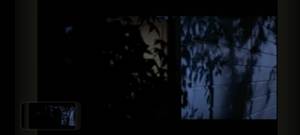
Halloween – above and below
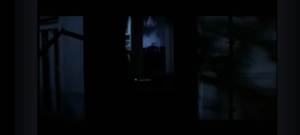
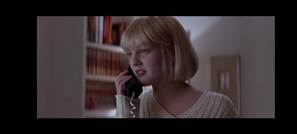
Scream – below
The film Halloween (1978, John Carpenter) was one of my main influences, with its opening scene creating an immediate sense of unease as the POV camera films outside the house, together with suspenseful music, intense blue filter and sharp, staccato high-pitched piano and violin discord.
The disturbing stalking element from Scream (1996, Wes Craven), was also a significant inspiration. The juxtaposition of ‘Casey Becker’ played by Drew Barrymore in Scream happily preparing popcorn in the comfort of her home, whilst being stalked by her killer outside, was something I was keen to emulate.
It was also important to me to try to create a surprise or twist element, inspired by The Gunfighter which escalates from humorous to absurd violence and About a Girl which delivers a gut-wrenching twist.
Creating Meaning and Effect
Filming throughout on a Nikon Z30, my establishing shots and mis-en-scene introduced my character and the mood/tone of the film, including shots of candles, wine and glasses to evoke a relaxed, romantic feel. For my first shot I panned right-to-left across the front of the fridge (careful for reflection) filming photos – two pictures of the same child at different ages (possibly a daughter), an old gentleman (possibly her father), but no-one else. Through the phone call, we would later establish she was single and this was her first date for a while.
I also included a cupboard shot at the beginning – a known go-to horror film technique – to making a subtle reference to horror films in general and also to continue the outside-in filming theme, but this time inside-in.
The sound throughout my film deliberately changed from romantic/relaxed for the inside shots of her alone, to tense and creepy for the outside filming, which was achieved by overlaying carefully selected stock piano chords and sound effects. I didn’t add these sound elements for the very first outside shot so as to subtly introduce my stalker. In the early takes, I tested diegetic sound with my character physically turning-down the volume of the music playing from an internal speaker, then shifting to an outside POV shot with the internal music heard from the outside. It just didn’t quite work and the music couldn’t be properly heard. I therefore switched to non diegetic sound, and by adding the sound later could address the levels effectively as we shifted back and forth from inside to outside scenes. After much researching, I used ‘The Most Beautiful Thing’, by Bruno Major, the style and lyrics of which matched perfectly to the tone and sentiment of my envisioned film and in editing I ensured the tempo of the music and action was carefully synchronised, including the knocks at the door and the clicks of the gas cooker lighting. The song is about loving someone you’ve never seen and hoping things work out. I also planned the action in the film together with the song lyrics for certain specific moments in the film.
I changed the lighting throughout from warm and cosy inside to cold and austere for the outside POV shots. I achieved warmth by increasing the red/yellow tones and decreasing the blue tones (being careful to not impact my character’s skin tone), while also increasing the contrast and lowering the exposure so that the image was crisper and more professional. I also deliberately added other elements to bring in the red warmth, such as candles, the flames from the gas burner, my protagonist’s red fingernails/lipstick, the red tomatoes and the orange lighting in the entrance hall. I switched from the camera locked-onto the protagonist, to a POV shot from outside looking in with the colour of these outside POV scenes being more blue, green and purple creating a harsher more serious mood.
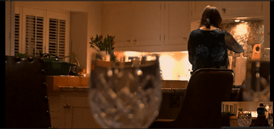
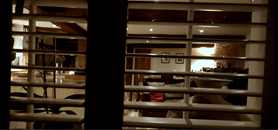
Behind Closed Doors – Different colour editing for inside versus outside filming
For most scenes with my protagonist, I used a ring-light on a warm tone behind the camera to cast shadows and lighting on her face, to enhance her facial expressions to make them easier to read when the camera was further away and to apply a more professional look to the film. Naturally, this made it more difficult to film to ensure the ring-light wasn’t visible or reflective through windows, mirrors, metal objects or glass.
The door scene where the stalker slowly and steadily walks towards the entrance to the house emulated the slow move to the door from Halloween. My film included a heartbeat drum sound that got louder and echoed the closer the camera got to the door heightening the tension and suspense for audience unease. As victim meets villain, I added a high-pitched violin sound which blended in nicely with the genuine creak of the door opening – signalling this critical moment where my protagonist was no longer safe.
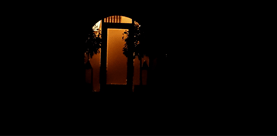
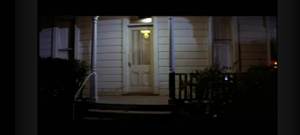
Behind Closed Doors vs Halloween
I tested-out numerous different camera angles/shots over the course of the film, including worm’s eye views, long/short, high/low, overhead and close-up, selecting the ones I think worked best. I tested filming the door opening through a POV shot and from behind the stalker’s shoulder (which was my final preference) to give him a sense of realism. His height made this difficult, but I managed with the use of a tripod attached to the camera and held-up to his eyeline. I also wanted to add-in a shot where I could see the protagonist opening the door from the inside but a giant immovable wall-hung mirror made that impossible.
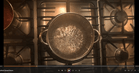

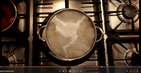
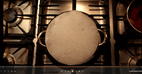
The birds-eye shot of the simmering, then boiling, then overflowing spaghetti-pot was intended to help build pace and anticipation. Moving back and forth between the stalker’s steady walk to the door and the water reaching boilover, symbolically represented we were near climax.
The knife my character uses at the start to cut her tomatoes is then how she is murdered at the end – dramatic irony incorporated in mis-en-scene (also used in Scream as Casey is stabbed to death with the same knife she picks-up in the kitchen at the start of the scene).
When filming the murder scene, I matched my character’s eye line and positioned my camera in front of his face, again using my tripod for length. I included a blackout – a classic horror film technique – for the murder scene alongside gruesome sound effects of blood squirting and slashed flesh to leave my audience unsure of exactly what’s coming. The blackout ends, my protagonist is dead and I included a radio crackling to effect a transition into the opening song to close the film. As with all the short films I studied, I sought to create a convincing story and take my audience on an emotional journey. I hope you enjoyed it as much as I enjoyed making it.
 Welcome to Perspective Film - by Izzy Brown